 Events
 Follow us on
 Follow us on
 Follow us on
Platform-News - 21.10.2026
Dear colleagues in the MaterialDigital community,
We look back on a successful and eventful start to autumn. We would like to thank everyone who participated in the MaterialDigital General Assembly 2026 and MSE2026 for their active contributions, open exchange and many fruitful discussions.
In this newsletter, you will find a brief recap of the General Assembly and MSE2026, along with further updates from the initiative – particularly on the newly published Special Issue.
Enjoy reading!
- MaterialDigital General Assembly 2026
- MaterialDigital at MSE2026
- DGM Pioneer 2026 | Award for Dr Tilmann Hickel
- Upcoming Events
- Current Publications | Special Issue
- Final reports on the projects from the first funding phase of the MaterialDigital initiative
MaterialDigital General Assembly 2026
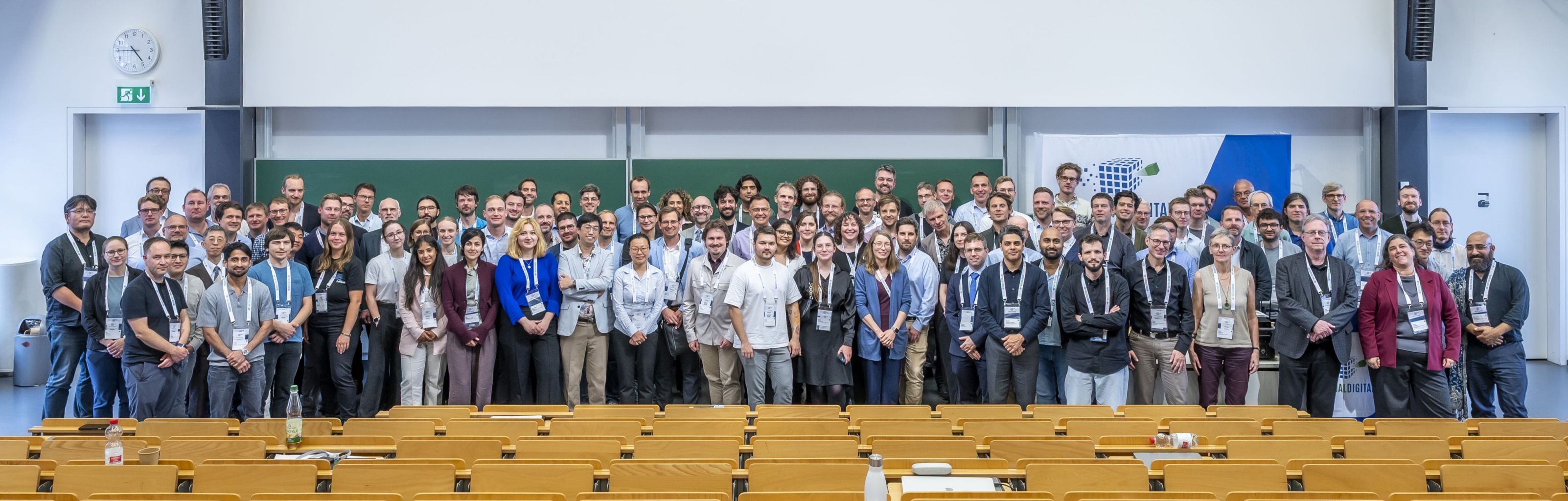
On 28 and 29 September, the MaterialDigital General Assembly 2026 took place at TU Darmstadt ahead of the Materials Science and Engineering Congress (MSE2026). The event focused on current developments within Platform MaterialDigital and its associated MaterialDigital projects.
Alongside insights into ongoing work and application examples from the platform’s projects and focus areas, the programme featured a poster and demonstrator session to encourage in-depth technical exchange. During the Industrial Panel Discussion, “What does industry gain from digitalization – and how should PMD evolve along?”, industry representatives discussed the tangible benefits of digitalization and how Platform MaterialDigital can continue to evolve in response to industry needs. The programme was complemented by workshops covering the platform’s focus areas. Further below in this newsletter, you will find perspectives on the event from the Workflows, Semantic Interoperability and IT Architecture focus areas.
Thank you to everyone who contributed to the success of the General Assembly through their presentations, contributions and discussions. The presentations and posters approved for publication are available in the Download Area.
Best Poster Award
Congratulations to Janik Harter and the DigiChrom team on receiving the Best Poster Award at the MaterialDigital General Assembly 2026. The award-winning poster was entitled “DigiChrom – Ontology development, alignment and knowledge graph access for chromium(III) electroplating”.
The contribution demonstrates how structured and semantically linked data can support the data-driven optimization of chromium(III) electroplating processes. By developing a domain-specific ontology and linking it to the PMD Core Ontology (PMDco), DigiChrom lays the foundation for making process data consistently available and using it to optimize more environmentally friendly coating processes with lower sensitivity to process variations.
The poster is available on the DigiChrom project website and in the Download Area for the General Assembly.
Best Demonstrator Award
We also congratulate Alexander Dyck and the DiStEL team on receiving the Best Demonstrator Award at the MaterialDigital General Assembly 2026. Their demonstrator, “Demonstration of Data Acquisition Pipeline and Data Models”, illustrated how data acquisition pipelines and data models work together to capture materials data in a structured way and make it usable for digital applications. Further information about the DiStEL project is available on the project website.
Partner Initiatives at the General Assembly
This year, we were also pleased to welcome representatives of various partner initiatives and other organizations. We would like to thank the National Institute for Materials Science (NIMS, Japan), the NFDI-MatWerk initiative, the Mantra-MaterialNeutral Hub, the MaterialsCommons initiative, the FAIRmat project and the QI-Digital initiative for their participation.
Exchange across initiatives helps identify shared needs and make the most of potential synergies. This allows developments to be better coordinated and digital solutions to be more closely aligned with the needs of research and industry.
Recap: Workflows
At the Platform MaterialDigital General Assembly 2026, Tilmann Hickel (BAM) and Jörg Schaarschmidt (KIT) presented recent developments and ongoing activities of the Workflows focus area. Tilmann Hickel highlighted the role of the pyiron workflow management system in enabling structured and interoperable simulation workflows, illustrated by its application in multiscale simulations of phase diagrams. The presentation also provided insights into recent developments in the pyiron ecosystem, including executorlib for scalable workflow execution, pyironflow for graphical workflow design, and pyiron_aiflow.
Particular attention was given to the Python Workflow Definition (PWD) as a common exchange format for workflows across different workflow management systems, alongside semantic annotation and integration with materials knowledge graphs. These developments contribute to improving the interoperability, reusability, and long-term sustainability of scientific workflows across the MaterialDigital community.
The perspective article on AI-readiness of the workflow solutions in the MaterialDigital community was highlighted, and the topic was further explored in the workshop on the second day.
In addition, the MaterialDigital projects highlighted the role of workflows in ensuring reproducible research and advancing AI-driven materials design, scientific simulations, and experiments.
The poster and demonstrator session fostered scientific exchange on the diverse workflow approaches adopted across the projects, ranging from established workflow management systems such as pyiron to custom solutions developed within individual projects and companies. The discussions also highlighted opportunities for collaboration, interoperability, and reuse of workflow solutions across the MaterialDigital community.
Workshop zu "Workflows as an Enabler of AI-Based Materials Design"
The workshop held during the PMD General Assembly 2026 offered practical insights into recent developments in SimStack and pyiron, with a particular focus on AI-assisted workflow creation and execution.
Following an introduction to AI readiness in digital workflows for materials science by Tilmann Hickel, a hands-on demonstration of SimStack II showcased AI-supported workflow development through an example involving a machine learning model for determining the chemical composition of steel in recycling applications.
The hands-on demonstration of pyiron showcased the modular construction of workflows by connecting individual nodes, as well as the semantic annotation of workflow nodes and data. Particular attention was given to emerging agentic AI capabilities, illustrated through two materials science applications: multiscale calculations of stress–strain curves in aluminum and the investigation of hydride formation near dislocations in nickel. Workshop notebooks and additional resources are available on the pyiron Workshop GitHub repository.
The demonstrations provided participants with an opportunity to explore the latest features of both workflow management systems and gain practical insights into how AI can support researchers and industry in developing and managing increasingly complex workflows.
A key takeaway was the potential to combine emerging AI capabilities with existing workflow infrastructures while maintaining semantic interoperability, transparent data handling, and reusable workflow components. This approach opens new possibilities for making advanced computational workflows more accessible while supporting their integration and exchange across different projects and research environments.
Recap and Workshops: Semantic Interoperability
With a total of five workshop sessions, the Ontology Team offered an extensive programme on semantic interoperability at the General Assembly. Participants could choose between a Beginner Track and an Advanced Users Track.
The Beginner Track introduced the fundamentals of ontologies, knowledge graphs and semantic interoperability. Another session provided an introduction to the PMD Core Ontology (PMDco) and the role of logical inference, known as reasoning, in its application.
The Advanced Users Track focused on the practical creation, validation and querying of knowledge graphs. Topics included SHACL and SPARQL, as well as various approaches to data transformation using Python and RDFLib, RML and OTTR. Further sessions explored reasoning with the PMDco and its development and modelling principles, including the reuse of existing concepts, semantic patterns and best practices for ontology extensions.
Insights | Moving Forward Together We were particularly pleased with the high level of participation in the workshops. It reflects the strong interest in our offerings and the underlying technologies. At the same time, it became clear that our ontology developments, especially the PMDco, are now being adopted by participating projects and increasingly by industry partners.
We have taken on board the frequently expressed desire for easier access and use. We are therefore continuously working to lower the barriers to entry, improve user interfaces and provide supportive tools. We also continue to offer advice and support within the project.
We warmly invite everyone interested to continue engaging with our community formats, such as the PMD Ontology Playground and in-person events such as the annual PMD Semantic Interoperability Hackathon (more information about the next hackathon, taking place from 18 to 20 November 2026).
We are also particularly keen to receive feedback on the PMDco, especially from industry: Is the PMDco already being used? If not, what are the reasons? What challenges remain, and which concepts or changes are needed? Feedback and concrete suggestions can be contributed to the open development process via the PMDco GitHub issues. We look forward to continuing the exchange and further developing the PMDco together.
Recap & Workshop IT Architecture and Infrastructure
The IT Architecture and Infrastructure focus area hosted a workshop covering two topics related to the application of PMD concepts and offerings.
Demonstrator & DataPortal
In the first part of the workshop, Marian Bruns and Heiko Hafok introduced participants to the use of the PMD infrastructure in connection with the MaterialDigital DataPortal. The session focused on the PMD Infrastructure Demonstrator, using steel tensile testing as an example. A deep dive into a Python notebook illustrated how to interact with the DataPortal, including querying semantically enriched data using Python and SPARQL, as well as a brief data preparation step with pyiron.
X-Dataspaces
In the second part of the workshop, Thomas Hanke addressed the integration of industrial data spaces. Following an overview of the DataPortal, industrial data spaces such as Catena-X were introduced. The subsequent deep dive focused on pipelines for preparing data for X-Dataspaces. Participants were shown how PMD-based ontologies can be mapped to Asset Administration Shell (AAS) models, which are used, for example, in Catena-X.
MaterialDigital at MSE2026
Platform MaterialDigital had a strong presence at MSE2026, particularly in Topic D – Digital Transformation. Hossein Beygi Nasrabadi presented the PMD Core Ontology (PMDco), Felix Thonagel introduced the Heat Treatment Ontology, and Kamilla Zaripova presented the NOES-Onto application ontology. Divya Gosula presented the collaboration between the National Institute for Materials Science (NIMS) in Japan and Platform MaterialDigital. The presentation focused on linking the Research Data Express (RDE) pipeline with the PMD Core Ontology to automatically transform heterogeneous materials data into semantically structured data.
Tilmann Hickel (BAM) and Jörg Schaarschmidt (KIT) highlighted recent developments in digital workflows for materials research, including work carried out within Platform MaterialDigital. The MaterialsCommons initiative was also represented in Topic D, with presentations by, among others, Tejs Vegge and Gerhard Goldbeck. We welcome the thematic overlaps and the opportunities they create for further collaboration.
Contributions from funded MaterialDigital projects also demonstrated the practical application of PMDco. For example, Konstantin Gubaev presented a PMDco-based application ontology for modelling industrial process chains in the KupferDigital2 project.
PMD also took centre stage in the poster programme. The MatSus poster received the Best Poster Award in Topic D. This PMDco-based application ontology links material concepts, processes and sustainability information relating to recycling, resource efficiency and life cycle assessment (LCA), as well as indicators such as the carbon footprint. One illustrative use case demonstrated the traceability of materials and processes throughout the life cycle. The poster is available in the Download Area.
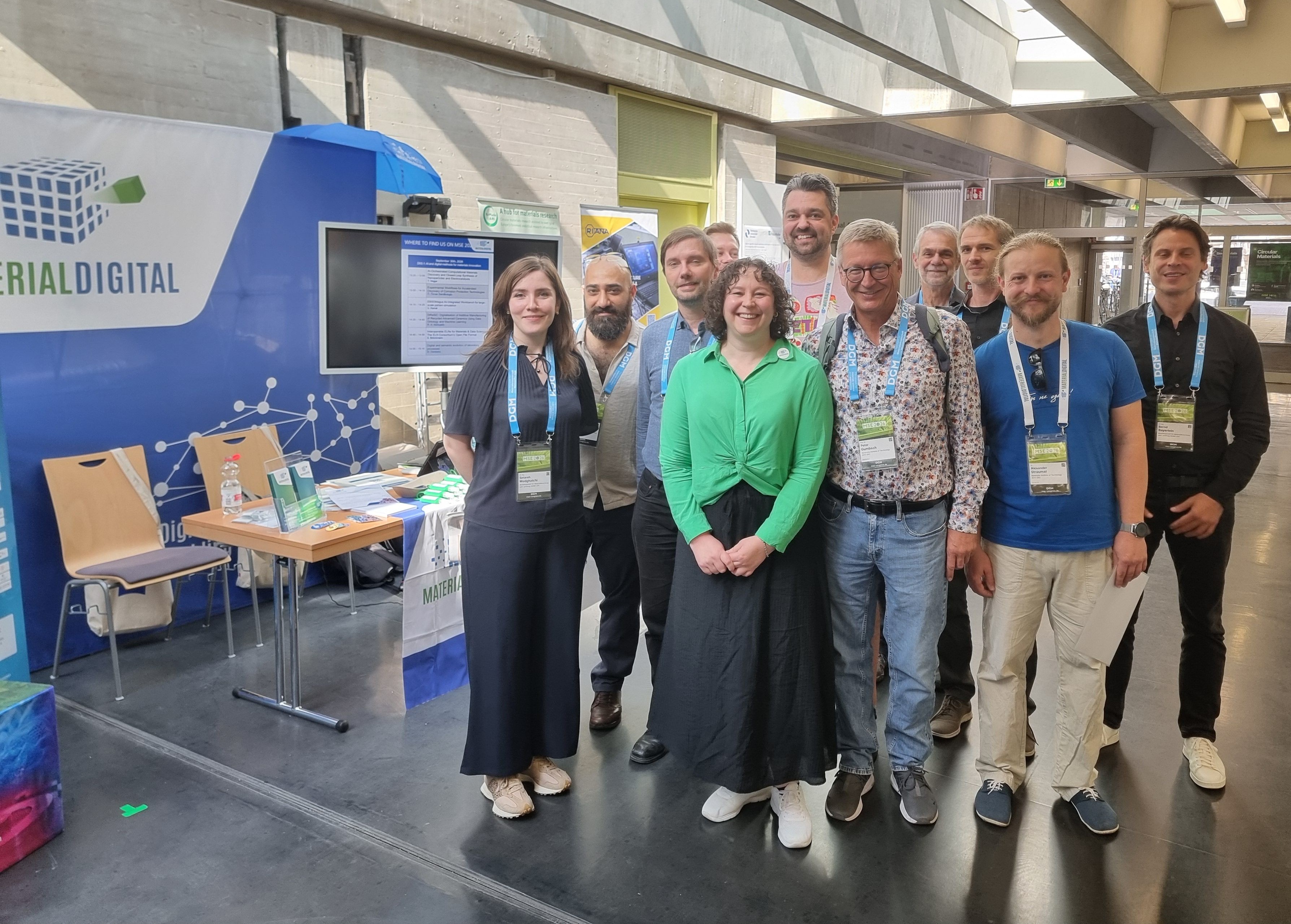
Platform MaterialDigital also had its own booth in the exhibition area, directly next to the NFDI-MatWerk initiative. This year, we also welcomed the MaterialsCommons initiative as a guest at our booth. The booth provided an opportunity for numerous conversations with congress attendees and for exchanging ideas with related initiatives on current developments and shared topics in the digitalization of materials science and engineering.
Special thanks go to our MaterialDigital colleagues for their great commitment and for showcasing the initiative’s solutions and results at MSE2026 and actively contributing to the scientific exchange.
DGM Pioneer 2026 | Award for Dr Tilmann Hickel
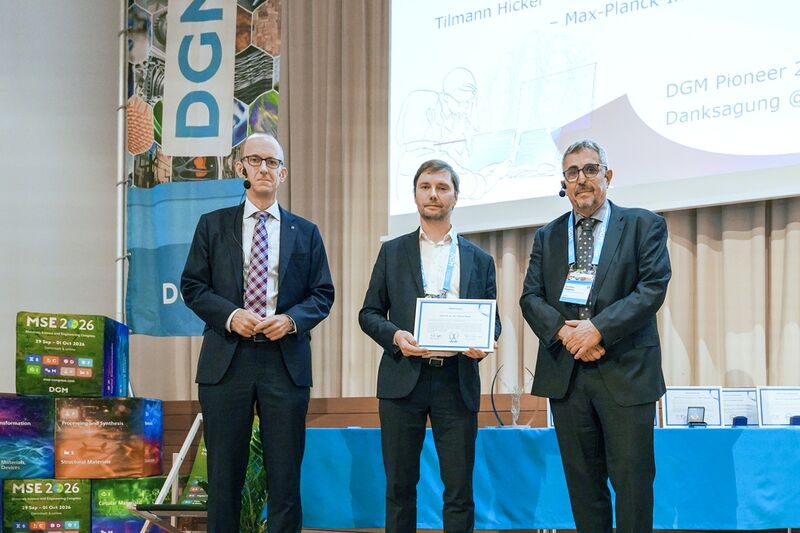
Another highlight around MSE2026 was the presentation of the DGM Pioneer Award 2026 to Dr Tilmann Hickel (BAM), co-spokesperson for Platform MaterialDigital and the NFDI-MatWerk consortium. The German Society for Materials Science (DGM) recognised his outstanding contributions to computational materials science and materials informatics, as well as to the transfer of digital methods into industrial materials development. His work brings together simulations, digital workflows and interoperable research data.
We warmly congratulate Tilmann Hickel on this well-deserved award.
Upcoming Events
4th PMD Hackathon – Registration Open
The fourth PMD Hackathon to promote semantic interoperability will take place from 18 to 20 November 2026 at BAM in Berlin-Steglitz (from lunch to lunch).
The focus will be on further developing and improving the PMD Core Ontology (PMDco) and addressing related questions. The hackathon offers an opportunity to bring forward your own topics and challenges, discuss them with ontology experts and work together to develop concrete solutions.
Everyone interested is welcome to contribute their own questions and take part in collaborative ontology engineering.
For further information, please visit the PMD Semantic Interoperability Hackathon 4 website.
Please register via this link.
Current Publications | Special Issue
Advanced Engineering Materials: New Special Issue on “Digitalization and Materials Information” Now Complete!
We are delighted to announce that the second special issue of Advanced Engineering Materials on digitalisation in materials science and materials engineering has now been published in full. The special issue “Digitalisation and Materials Information” brings together contributions from the MaterialDigital, NFDI-MatWerk and DIADEM initiatives. All articles from the special issue are now available in one place here.
Translated with DeepL.com (free version)
We would like to thank all authors from our projects and Platform MaterialDigital for their contributions.
The first special issue in this series, featuring contributions from the MaterialDigital initiative, was published in April 2025. It brings together methods and results from the first phase of the project.
Some contributions to the new special issue were published online ahead of the complete issue. The following articles have recently become available:
-
“Supporting AI Readiness Through Digital Workflows in Materials Science” by Bruns et al. (2026)
-
"Detecting Anomalous Cell Behavior in Electrochemical Battery Testing Using Machine Learning", by Rose et al. (2026)
Final reports on the projects from the first funding phase of the MaterialDigital initiative
In addition to the first special issue of Advanced Engineering Materials, the final reports on the projects from the first funding phase of the MaterialDigital initiative are now also publicly available. They document the key results of the completed projects and their subprojects. The public sections of the reports were submitted to the Leibniz Information Centre for Science and Technology and University Library (TIB) in accordance with the funding guidelines of the German Federal Ministry of Research, Technology and Space (BMFTR) and published in the Repository for Natural Sciences and Technology (ReNaTe). The final reports can now also be accessed collectively on our website.
We wish you a pleasant autumn and look forward to staying in touch. Follow us on LinkedIn and visit our website.
If you have any questions, you can reach us at info@material-digital.de or via our contact form.
The PMD team