 Events
 Follow us on
  Follow us on
  Follow us on
 Platform-News - 20.07.2026
Dear colleagues in the MaterialDigital community,
What’s currently going on within the MaterialDigital initiative? From the results of the industry event in Karlsruhe to the launch of the MaterialsCommons initiative and the latest progress in our focus areas. In recent weeks, there have been numerous developments that are driving the digital transformation of materials science and engineering. In addition, we’re highlighting the first articles from the Advanced Engineering Materials special issue “Digitalization in Materials Science and Engineering – Part II” and providing information on important submission deadlines leading up to the MaterialDigital General Assembly. Take a look at the newsletter!
Past Events
MaterialDigital Industry Event 2026: Dialogue with Industry
With a large number of participants from industry, research, and politics, the MaterialDigital Industry Event 2026 was a resounding success. Over the course of two days, the focus was on the potential of digital material data and data-driven collaboration for a competitive industry. Under the motto “Germany at China Speed?”, discussions centered on how digital technologies can accelerate development and innovation processes, strengthen the resilience of industrial value creation, and help Germany remain competitive on the global stage. Key topics included digital material data as the foundation for more efficient development processes, industrial data rooms for secure data exchange, and the integration of artificial intelligence into material development and production.
Another key focus was on current topics such as the Digital Product Passport and the circular economy. Practical insights and interactive workshops demonstrated how companies are already successfully implementing these approaches today and what conditions must be created to enable scalable digitalization.
The in-depth technical exchange and lively discussions made it clear that the digitization of material data is seen as the key to innovation, sustainability, and international competitiveness. A broader perspective emerged repeatedly: if the scientific community, policymakers, and industry in Germany and Europe cooperate rather than placing the burden of responsibility on one another, we can secure our competitiveness in the long term!
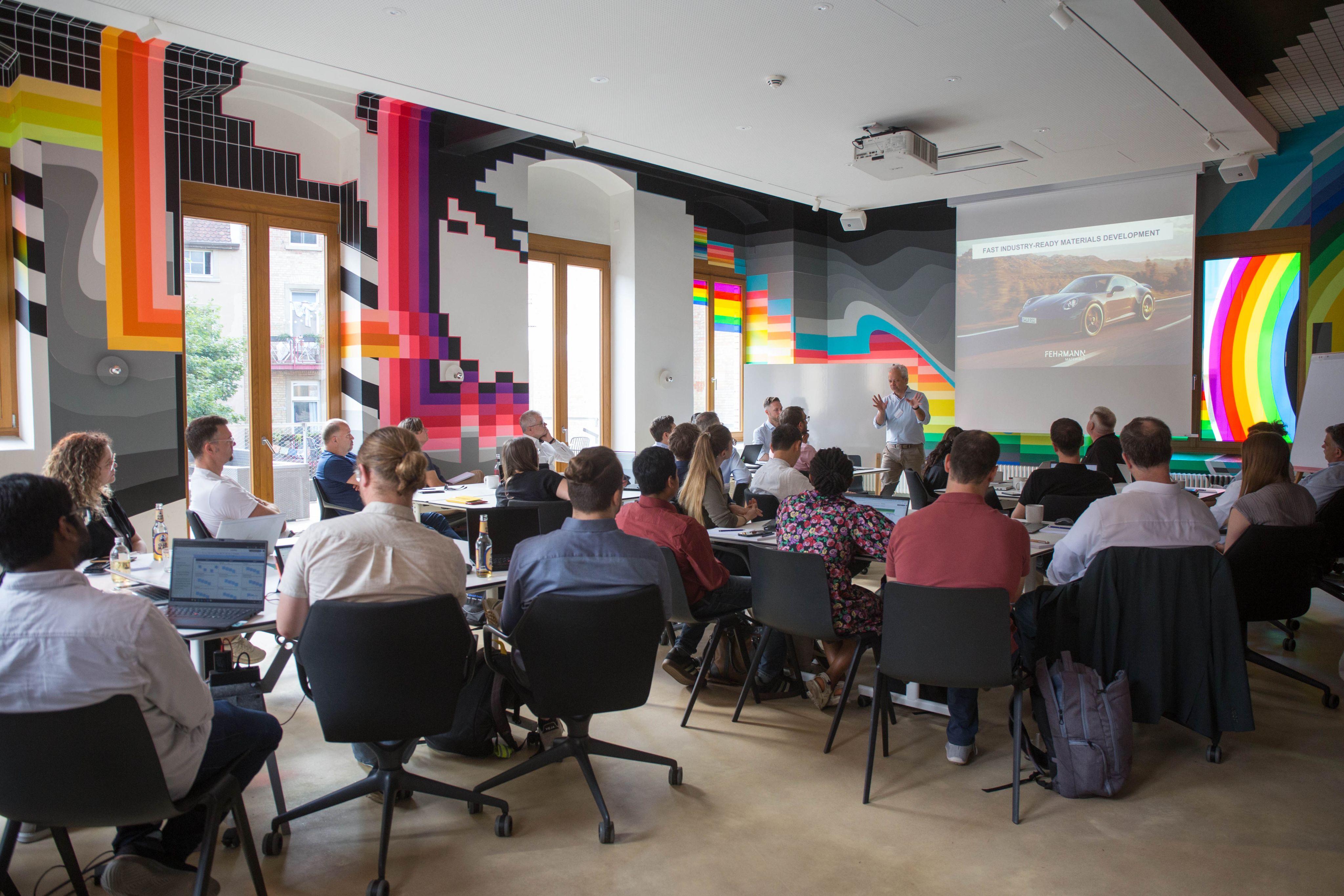
We would like to express our sincere thanks for the active participation and positive feedback, and we look forward to continued collaboration within the MaterialDigital community.
Information about the event can be found here.
Launch of MaterialsCommons: Connecting European Materials Research
MaterialsCommons is a new European initiative designed to simplify and connect access to materials data, digital tools, and workflows through a shared infrastructure. The goal is to accelerate the development of new materials through better data utilization, interoperable processes, and AI-supported approaches. The Platform MaterialDigital is contributing its expertise and solutions to the project and helping to transfer successful concepts for data spaces, semantics, and digital workflows to the European level.
At the kick-off meeting on June 17, 2026, at the Karlsruhe Institute of Technology (KIT), the project partners came together to launch their collaboration for the next four years and lay the groundwork for a networked European research infrastructure in the field of materials. Learn more about the launch of the MaterialsCommons initiative in the latest press release.
As a supporting partner of MaterialsCommons, the Platform MaterialDigital looks forward to contributing its experience and findings to this European initiative. This close collaboration offers the opportunity to further develop proven approaches from the community, raise visibility at the European level, and work together to build an interoperable digital infrastructure for materials science and engineering. The coming years promise exciting exchanges and a wide range of synergies.
NeReS Network Conference: Discussion on Sustainable Resource Systems
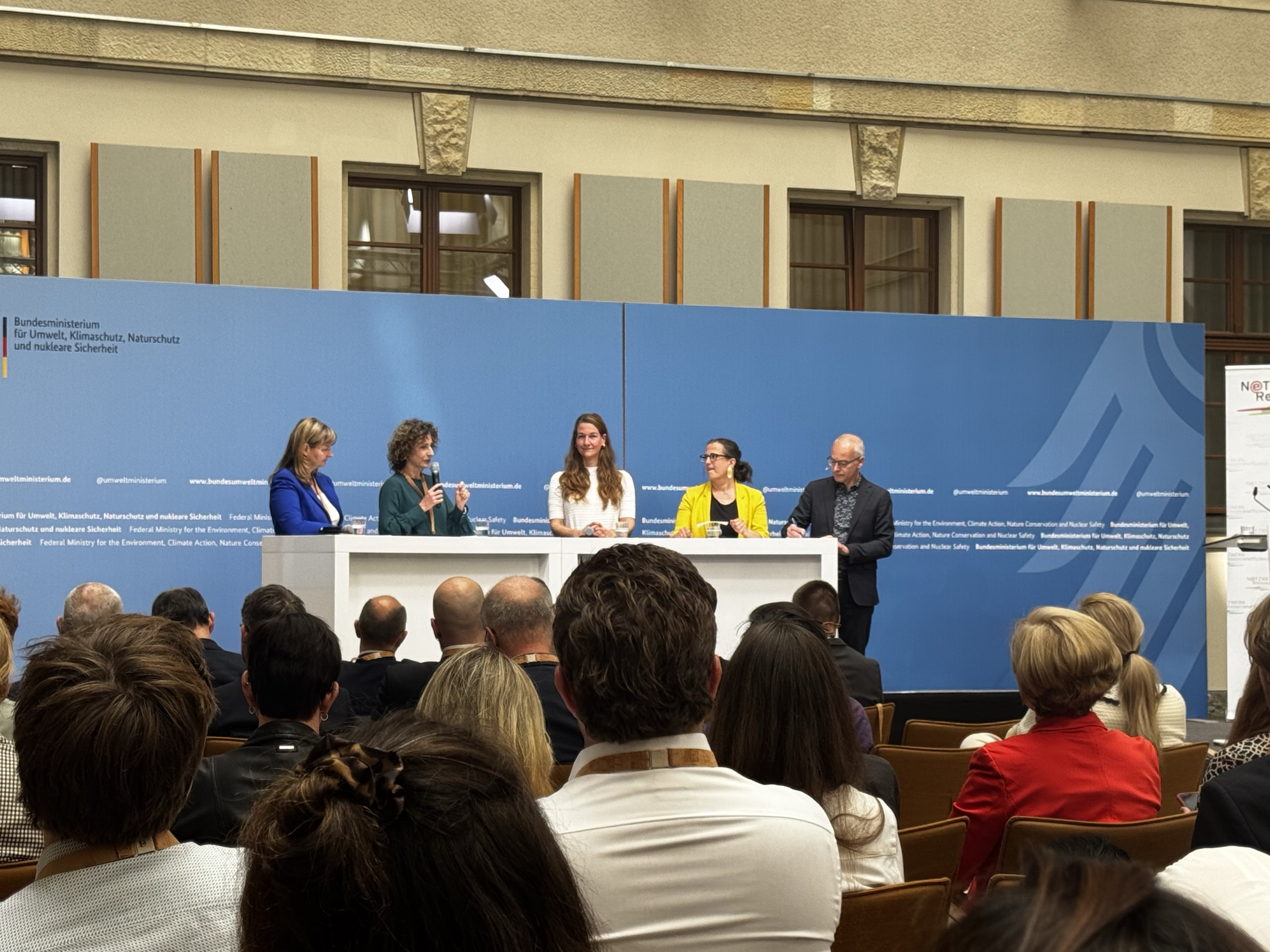
The NeReS-Netzwerkkonferenz held in May 2026 focused on digital value chains as a key prerequisite for a resource-efficient and circular economy. Discussions centered in particular on interoperable data flows, appropriate standards, data quality, and the secure exchange of information among the participating stakeholders.
The Digital Product Passport was highlighted as a key component for greater transparency, traceability, and more efficient use of resources throughout the product life cycle. Successful practical examples and pilot projects from various industrial sectors also illustrated the potential of sensor-based and AI-supported applications in establishing an efficient circular economy - for instance, for condition assessments, more efficient use of materials and packaging, and optimized recycling and sorting processes.
The discussions made it clear that reliable, machine-readable, and interoperable data form a central foundation for digital transformation and the implementation of circular value chains. This creates clear links to the goals of MaterialDigital, particularly the interconnection of data, stakeholders, and digital solutions along material-related value chains.
LLM Meets Materials Science: Impressions from the BAM–Fraunhofer Materials LLM Days
How can large language models support materials research in the future? This question was the focus of the BAM–Fraunhofer Materials LLM Days II, held on April 27 and 28, 2026, at the BAM Adlershof campus. Experts from research, industry, and the Fraunhofer Materials Group came together to discuss current developments and specific applications of LLMs and other AI methods.
The program showcased a broad spectrum of potential applications: from AI-supported materials design and simulation to automated extraction and structuring of scientific metadata and intelligent software and laboratory workflows. Other key topics included knowledge graphs, multi-agent systems, data-driven closed-loop experimental cycles, and the semantically coordinated reuse of multimodal material data.
Topics related to digital quality infrastructure were also addressed, such as concepts for machine-interpretable quality and reference documents. This highlighted that LLMs can not only accelerate individual work steps but also, in the long term, contribute to more interconnected, traceable, and data-driven research processes.
At the same time, it was emphasized that reliability, traceability, security, and data quality remain crucial prerequisites for the responsible use of these technologies. The event provided an inspiring setting for professional exchange, new ideas, and the further development of joint activities.
Upcoming Events
Online Community Meeting on July 21: Focus on two Demonstrators
Join us for the next MaterialDigital Community Meeting on Tuesday, July 21, 2026, from 1:00 p.m. to 2:00 p.m. The meeting will focus on two demonstrators that show how various tools on the Platform MaterialDigital interact and can be used together.
Demonstrator 1: From the Data Lifecycle to Collaborative Data Use with PMD
(Marian Bruns)
The first part focuses on how the various stages of a data lifecycle can be implemented using PMD tools via Python:
- Uploading (semantic) data for collaborative querying and editing, using Ontodocker as an example (data generation, upload, and update)
- Creating and populating datasets in the MaterialDigital DataPortal (data publication)
- Querying and exploring data in the DataPortal
Finally, an outlook is provided on how data sets can be collaboratively worked on in decentralized, non-public data spaces within the PMD Mesh. The demonstrator video “From Data to Insights: Platform MaterialDigital in Practice” already provides a first impression.
Demonstrator 2: Semantic Data Integration for Industrial Data Spaces
(Matthias Büschelberger)
This demonstrator showcases the IWM strategy for transforming data from ELNs (Electronic Lab Notebooks) and LIMS (Laboratory Information Management Systems) such as OpenBIS into semantic documents based on PMDCo (Platform Material Digital Core Ontology) or other digital standards such as SAMM (Semantic Aspect Meta Model) or AAS (Asset Administration Shell) for exchange in industrial data spaces such as Catena-X, Manufacturing-X, etc.
This was achieved through the use of open standards for data transformation (YARRRML and SPARQL) as well as open-source software (e.g., CKAN and its community-driven plugins).
Assets are published and exchanged via Eclipse Dataspace Connector instances, which provide the technical foundation for the Dataspace protocol and thus enable sovereign data exchange on an industrial scale. Based on these components, the architecture implements bidirectional linking and full traceability: Internal production and characterization data are linked to external product data from supply chains – and vice versa.
The meeting is scheduled to last one hour. After the brief presentations, there will be plenty of time for your questions and a general discussion.
Please use this opportunity to actively help shape the demonstrator workshop at the general assembly: Which topics would you like to explore in greater depth there? Which application examples would help you better achieve your project’s goals?
To receive the registration link, please send an email to: community@material-digital.de.
2026 General Assembly: Submit Your Contributions Now
Registration for the Platform MaterialDigital General Assembly on September 28 and 29, 2026, in Darmstadt is still open. Play an active role in shaping the program and present your work to the MaterialDigital community. Whether it’s a project presentation (especially from MaterialDigital 2 and 3), a poster, or a demonstrator - take this opportunity to present your results and engage in dialogue with stakeholders from academia and industry.
Please note the upcoming submission deadlines:
- August 21, 2026 – New Deadline for Project Presentations: Submission of abstracts for MaterialDigital project presentations on September 28, 2026. Please include the name of your MaterialDigital project. This deadline has been extended to August 21. Abstracts and presenter information can be updated until September 21.
- September 21, 2026 – Final deadline for abstract updates Abstracts already submitted can be supplemented with current information or revised by this date.
- September 21, 2026 – Deadline for demonstrators and posters Demonstrators and posters can be submitted online by September 21. Only registered submissions will be considered for the Best Demonstrator and Best Poster awards.
All information and links regarding submissions can be found here.
MSE 2026: Discounted Registration for General Assembly Attendees
Following the MaterialDigital General Assembly, the Materials Science and Engineering Conference (MSE 2026) will begin on September 29, 2026, at TU Darmstadt.
Participants in the General Assembly have the opportunity to purchase a discounted MSE ticket. To be able to do so, you must be registered for and have paid in full for the General Assembly. Further information on the ticket offer can be found on the General Assembly registration page.
MSE 2026 will take place from September 29 to October 1, 2026, as a hybrid event in Darmstadt and online. The preliminary program has already been published and includes a wide range of scientific sessions, plenary lectures, and other program items.
Poster submissions for the in-person event can be submitted until July 31, 2026. Extended submission deadlines apply to online posters.
Visit us at MSE at Booth No. 12
Take advantage of the opportunity to combine the MaterialDigital General Assembly with Europe’s largest conference on materials science and engineering, and be sure to stop by our exhibition booth— No. 12, right next to the auditorium.
For more information, visit the MSE 2026 website.
Insights into the PMD | Focus Areas
Learn more about current developments and ongoing work in the main areas of the MaterialDigital platform.
Community Interaction
MaterialDigital3 Project Presentations
During three MaterialDigital community meetings, six projects from the third MaterialDigital call for proposals each gave a 10-minute presentation to introduce their work. The projects, which launched in 2025, are still in their early stages and offered exciting insights into their goals, approaches, and initial activities.
Under industry leadership, they are working on digital transformation across various material and value chains—from steel, glass, and ceramics to polymers and copper, and on to sustainable plastics and recycling processes. The brief presentations offered participants a concise overview of the diversity of the projects and fostered discussion about shared challenges and synergies.
Did you miss the presentation? Then feel free to visit the project websites, where the profiles are available.
We would like to extend our sincere thanks to all the presenters for their presentations and their contribution to the open exchange of knowledge within the MaterialDigital community.
Workflows
The Workflows focus area is bringing current developments from Platform MaterialDigital into European and international initiatives. Within the European project MaterialsCommons, Platform MaterialDigital is participating as a funded project partner. Within the consortium, BAM, together with KIT, leads Work Package 4 “Unifying Computational Workflow Environments”. The aim is to harmonise computational workflow environments and create the basis for interoperable, federated research infrastructures. This expands the workflow group’s activities, which have so far focused on Germany, to the European level and involves international partners in the field, such as AiiDA and Perqueue.
As part of its international networking activities, the workflow team also co-organised the CECAM Flagship Workshop “Open Databases Integration for Materials Design (OPTIMADE)”, which took place in Grenoble from 29 June to 3 July 2026. The workshop focused on open standards for materials databases, the integration of digital workflows, and the further development of interoperable infrastructures for materials research. During the workshop, a module for evaluating the Common Workflow Language (CWL) was developed. It enables data described in CWL to be transformed into knowledge graphs modelled using PMDco with the help of semantikon. At the same time, a communication channel with the CWL community was established to facilitate the further development of CWL and Python Workflow Definition (PWD).
Collaboration with the Semantic Interoperability focus area
Following the successful use of semantikon to export PMDco-based workflow knowledge graphs for directed acyclic graphs (DAGs), current development focuses on supporting control flows. The first draft for modelling for loops has now been completed and has already been validated using reasoners. In the coming weeks, the remaining control flow constructs, particularly while loops and if-else branches, will be implemented and evaluated. The results obtained will subsequently be published.
Software developments for workflow representation
As described in previous newsletters, the software package flowrep was developed to standardise workflow representations. The integration of flowrep into pyiron_workflow has now been fully completed. This results in the following improvements:
- Workflows in pyiron_workflow no longer require a pyiron_workflow-specific syntax. This allows workflows to be written easily by any developer with Python knowledge.
- Workflows can be semantically validated using semantikon, and the information generated in the process can be directly transferred into corresponding knowledge graphs.
To ensure the provenance of the software tools used in workflows, we have developed a new software package pothenon. pothenon analyses Python code based on its Abstract Syntax Tree (AST) and recursively detects dependencies of Python functions as well as software packages used within the code.
Semantic Interoperability
Ontology Playground – Connecting Data Together
How can we achieve true interoperability in MaterialDigital? The MaterialDigital community comes together in the PMD Ontology Playground to address exactly this question.
In a biweekly online format, experts from the projects meet to learn from each other – openly, practically, and collaboratively. Whether first concepts or concrete results: The Playground provides space to make approaches to data integration visible, receive input on challenges, get feedback, and take away new impulses.
Shape the process instead of just listening.
All projects are invited to contribute their perspectives and actively become part of the community. Present your project in the Playground!
Discuss your specific challenges and benefit from the feedback of other experts – together, we are advancing semantic interoperability in MaterialDigital.
Book a slot for your project contribution!
Join the mailing list for participation!
Tools and Services Walkthrough Session - Ontology II – Exchange, Practice & Consensus
Building on the first Ontology Walkthrough Session, which primarily provided an introduction to ontologies, the second session on 23 June was aimed at participants with initial prior knowledge and practical experience with ontologies.
The first part of the walkthrough focused on key aspects of advanced ontology development – from modelling processes, consensus building, and granularity to technical topics such as IRIs, modularisation, imports, ODK, and ROBOT. RDF-based data transformation, mapping approaches, and links to AI were also addressed.
In the second part of the walkthrough, selected modelling patterns were presented and discussed to provide practical insights into the concrete and more complex modelling of materials, properties, and processes – including the duality of object and material, process chains, input-output structures in manufacturing processes, and the role of objects in measurement processes. The exchange with participants provided valuable insights into current challenges – ranging from the need for basic documentation and introductory resources for getting started, to the question of what can actually be achieved with PMD ontologies, as well as the integration of different ontologies and data sources.
One key aspect became particularly clear throughout the discussions:
Consensus is a central component in building ontologies.
Participants were encouraged to contribute to the regular modelling meetings, where modelling questions are jointly discussed, coordinated, and PMDco is continuously developed further.
Another impulse from the group was the desire to bundle efforts where multiple projects are working on similar or shared ontology domains.
The workshop presentation slides are available in the download area.
Current Publications
Find out about recent scientific publications from the field of the MaterialDigital initiative and its projects.
-
Markus Schilling, Niklas Marschall, Ute Niebergall, Martin Böhning
FAIR data in mechanical testing of polymers: Implementation of the full-notch creep test ontology (OntoFNCT) | Results in EngineeringThe application ontology OntoFNCT transforms data from full-notch creep tests on polymer materials into a FAIR-compliant, machine-readable structure, enabling interoperable data storage, automated evaluation, and easier reuse. It is based on the PMD Core Ontology (PMDco) and demonstrates how PMDco can serve as a semantic backbone for specific testing methods in materials science, in this case in polymer science and polymer material characterisation.
-
Markus Schilling, Harald Bresch, Bernd Bayerlein, Bastian Ruehle
WeChemSynOntology: semantic modeling of wet chemical syntheses in a self-driving lab for nano- and advanced materials | Digital DiscoveryThe WeChemSynOntology presented in this publication provides a semantic foundation for describing wet chemical synthesis processes for nano- and advanced materials in a clear, machine-readable, and reproducible way across laboratories. The work addresses a key requirement for self-driving labs: robotic platforms require precisely modelled process steps and parameters in order to autonomously plan, execute, evaluate, and share experiments. The implementation demonstrated at the Bundesanstalt für Materialforschung und -prüfung (BAM) provides an example of how such semantic representations can help make automated materials synthesis interoperable and reusable across different laboratory infrastructures and orchestration systems in the future.
Special Issue
Advanced Engineering Materials: Special Issue on “Digitalization in Materials Science and Engineering” – Part II
With the publication of the first special issue of Advanced Engineering Materials featuring contributions from the MaterialDigital initiative in April 2025 (https://advanced.onlinelibrary.wiley.com/toc/15272648/2025/27/8?campaign=woletoc), an overview of the methods applied and the results achieved during the first phase of our initiative was presented.
The second part of this special issue, featuring contributions from the MaterialDigital initiative, NFDI MatWerk (https://nfdi-matwerk.de/), and the French initiative DIADEM (https://www.pepr-diadem.fr/en/), is currently being compiled and is expected to be published in autumn this year.
Individual contributions from this collection have already been published online.
GaNDigital
J. Tomkovič, G. Lukin, H. Torkashvand, A. Kerschbaum, M. Müller, S. Besendörfer, J. Heitmann, J. Friedrich - (April 2026)
DiProMag
Fostering Innovation: Streamlining Magnetocaloric Materials Research by Digitalization
Simon Bekemeier, Moritz Blum, Luana Caron, Alisa Chirkova, Philipp Cimiano, Basil Ell, Inga Ennen, Michael Feige, Maik Gaerner, Thomas Hilbig, Andreas Hütten, Günter Reiss, Tapas Samanta, Sonja Schöning, Christian Schröder, Lennart Schwan, Chris Taake, Martin Wortmann - (May 2026)
InSuKa
Optimization of the Production of Rubber Compounds Using Mathematical Models
Anke Bardehle, Andreas Limper, Ulrich Giese, Carlos Lucke, Mario Beiner, Christoph Gögelein, Lisa Leuchtenberger-Engel, Christian Hopmann - (May 2026)
DaMaStE
Lisa Beran, Vincent Nebel, Dominik Perius, Kshitij Kumar, Yannis Heim, Laura Bies, Tobias Kraus - (June 2026)
DigiChrom
Christoph Baumer, Christopher Mai, Luca Eisentraut, Andreas Bund, Ricardo Buettner
From the Community for the Community
Call for Papers: Special Issue “Semantic Materials Science and Engineering (SMSE)”
The journal Semantic Web Journal (SWJ) is planning a special issue on “Semantic Materials Science and Engineering (SMSE)”. The call is looking for contributions addressing semantic technologies, knowledge graphs, ontologies, and AI methods for materials science and materials engineering. The topics mentioned in the Call for Papers include, among others:
- Ontological architectures for multiscale physics
- Domain ontologies (e.g. crystallography, defects, thermodynamics)
- Ontology design patterns
- Interoperability with BFO, EMMO, PMDco
- Neurosymbolic materials research
- Combination of knowledge graphs (KGs) and deep learning
- Prediction of material properties
- Semantic interoperability in production
- Asset Administration Shell (AAS)
- Semantic digital twins
- PSPP relationships (Processing–Structure–Property–Performance)
- Automated knowledge extraction
- NLP and Large Language Models (LLMs)
- Extraction of structured material data from publications and patents
- Ontology generation
- Autonomous neurosymbolic research assistants
- AI agents based on LLMs, knowledge graphs, and ontologies
- Support or automation of R&D workflows in materials science
- Provenance tracking and verification mechanisms for trustworthy results
- Decentralised data marketplaces
- Linked Data and Solid Pods
- Sovereign and secure exchange of material data
- Collaboration between science and industry
Submission deadline for contributions: 16 December 2026
Further information on the call and submission process:
- http://www.semantic-web-journal.net
- http://www.semantic-web-journal.net/authors
Stay connected with us: Follow us on LinkedIn and visit our website.
If you have any questions, please contact us at info@material-digital.de or directly via the contact form.
The PMD team